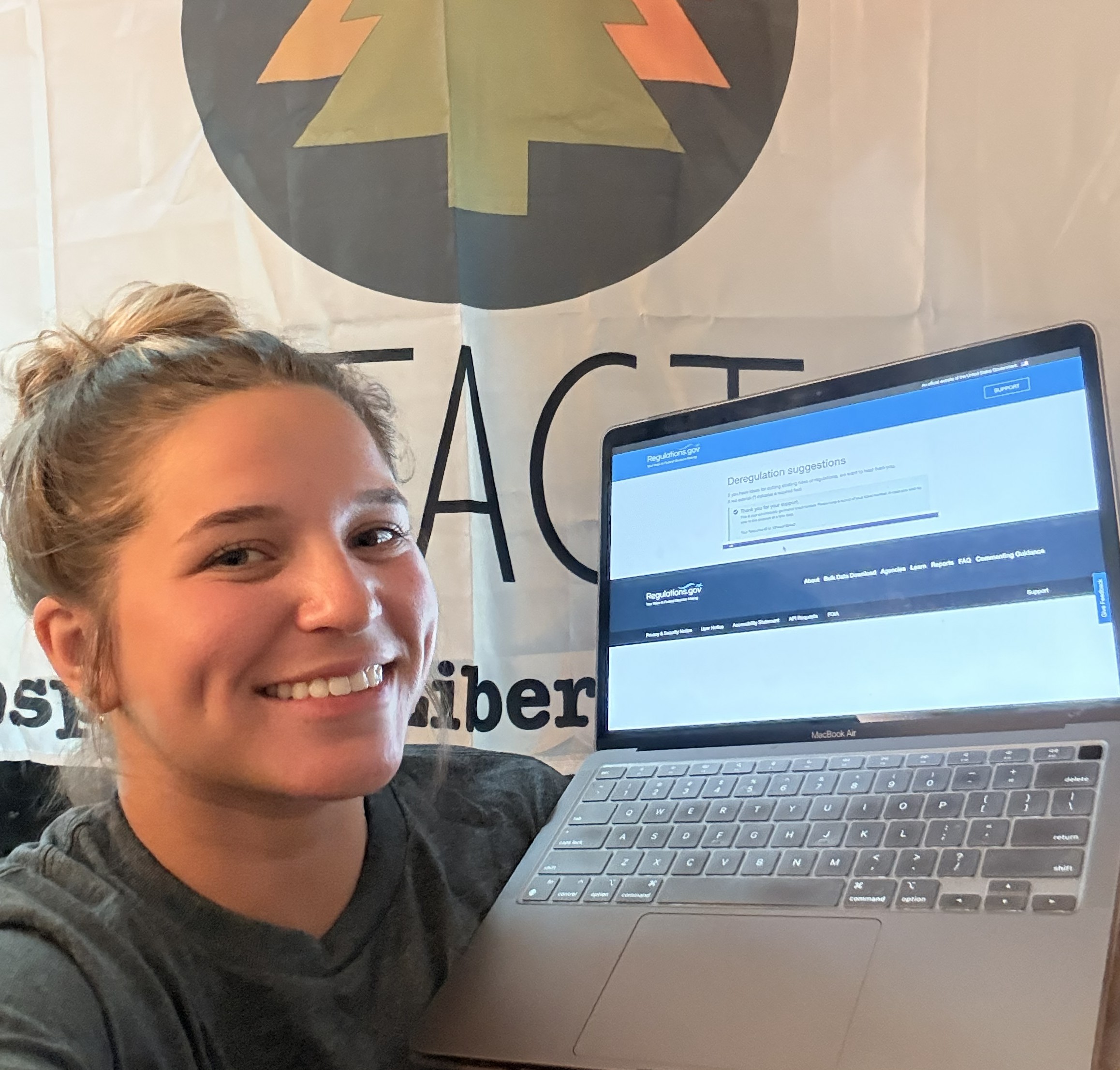
While most college students are busy preparing for finals, two CFACT Collegians took their advocacy beyond campus and straight into the federal rulemaking process—submitting formal deregulation proposals through Regulations.gov.
This unique opportunity allows everyday Americans to recommend rules for repeal or reform, giving students like Sophia Sousa of the University of Florida and Skyler Perez of CUNY John Jay College a direct voice in shaping national policy. Rather than simply reacting to government decisions, these Collegians stepped up to challenge the regulatory state itself.
It’s worth noting that the structure of the federal submission portal requires detailed, section-by-section responses—meaning comments of this caliber are far more technical and expansive than a typical public remark. Rather than a couple of succinct paragraphs, students are effectively drafting policy proposals, complete with regulatory citations, justifications, and implementation language.
Sophia Sousa (pictured above) set her sights on one of the most expansive climate reporting mandates in the country: the EPA’s Greenhouse Gas Reporting Program. Codified under 40 C.F.R. Part 98, the rule requires thousands of facilities to track and report emissions annually—an undertaking that Sousa argues imposes heavy costs while delivering little tangible benefit.
In her proposal, Sousa makes the case plainly: “The Greenhouse Gas Reporting Program imposes substantial compliance costs on energy producers as well as industrial facilities while providing only limited environmental benefits.” She further notes that “the rule duplicates existing state and federal reporting systems, creates unnecessary administrative burdens, and discourages domestic energy production.”
Expanding on that argument, Sousa emphasizes the broader economic impact, writing that “the GHGRP is primarily a data collection rule and does not directly reduce emissions,” and warns that “by increasing regulatory scrutiny and compliance burdens, the rule discourages investments in oil, gas, and manufacturing sectors.” Her recommendation is clear—rescinding the rule would reduce costs and remove a barrier to domestic energy development.
Further north, Skyler Perez took on a different but equally impactful set of policies—federal renewable energy mandates embedded across multiple agencies, including the Department of Energy and Federal Energy Regulatory Commission.
Perez’s proposal challenges the assumption that government-imposed renewable targets lead to better outcomes. As he explains, “federal rules require agencies and utilities to meet fixed renewable energy targets… [which] limit flexibility and push intermittent sources even when they do not match real-time grid needs.”
Pointing to performance concerns, Perez highlights the real-world limitations of these energy sources, noting that “solar output drops to zero every night and falls sharply in winter,” while “wind output can fall for days.” As a result, “these swings require constant backup from natural gas plants,” undermining the reliability these mandates were intended to ensure.
His solution is to move away from rigid quotas and toward practical outcomes: “fixed targets should be replaced with performance-based standards that allow agencies and utilities to select energy sources that match local grid needs.”
Together, these two students tackled different corners of the federal regulatory landscape, but their message is the same: one-size-fits-all mandates and bureaucratic reporting schemes are no substitute for innovation, time-tested, and market-driven solutions like natural gas and nuclear energy.
These submissions reflect the core mission of CFACT’s Collegians program—equipping young leaders not just to participate in environmental conversations, but to reshape them. By engaging directly with federal agencies and proposing substantive policy reforms, students like Sousa and Perez are proving that the next generation of leaders is taking on the regulatory status quo in name of climate realism.