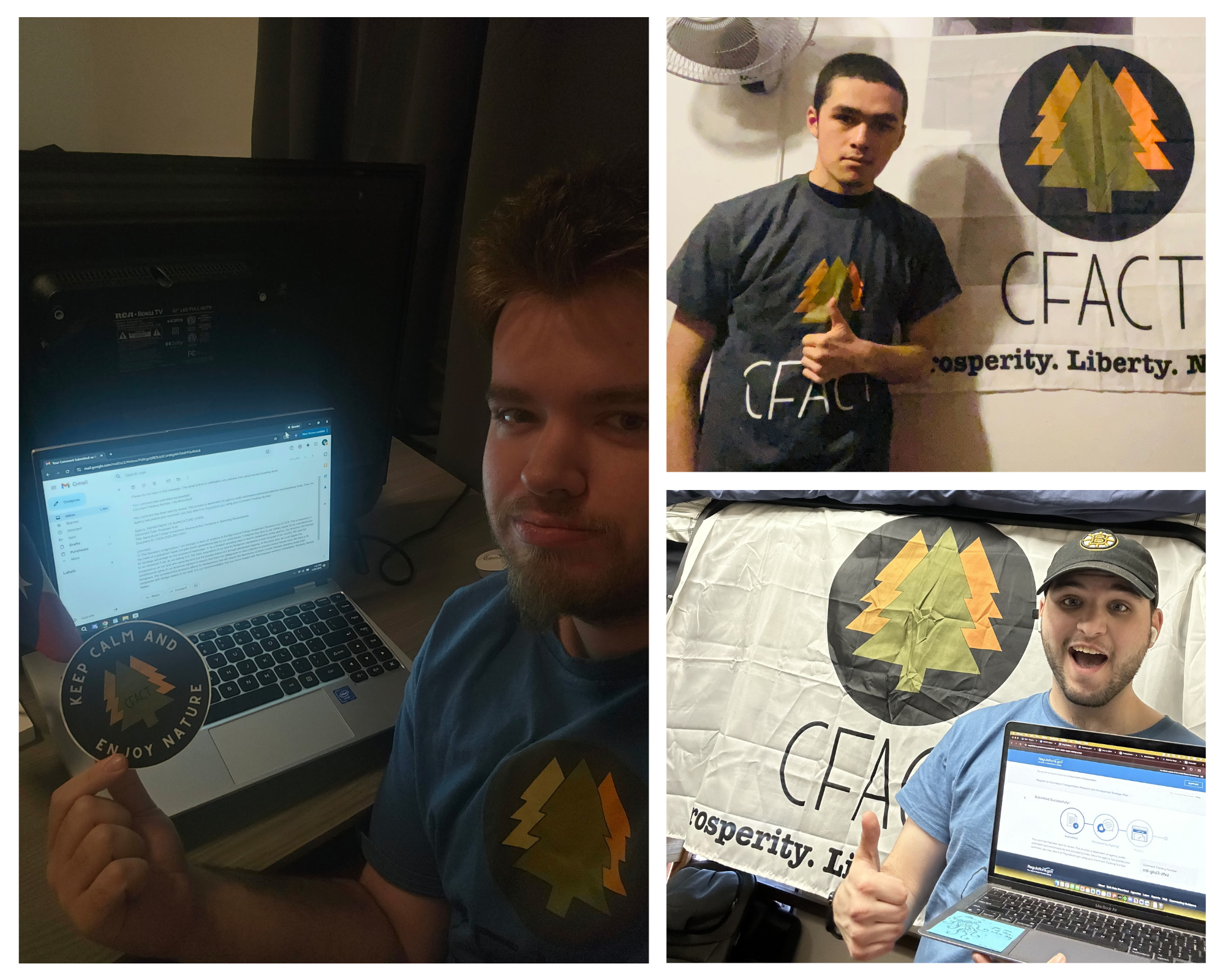
Students with CFACT Collegians continue to make their voices heard in the federal rulemaking process by submitting formal public comments on policy proposals affecting energy reliability, mineral supply chains, and agricultural land ownership. Public comments give citizens an opportunity to weigh in on regulatory decisions before agencies finalize new rules, ensuring policymakers hear directly from those who will live with the consequences. Recently, three students — Nicolas Walker of Sam Houston State University, Skyler Perez of the City University of New York (CUNY John Jay College), and Silas Pearson of Liberty University — each submitted comments addressing separate federal proposals.
One comment opportunity came through the U.S. Department of Agriculture regarding proposed revisions to the Agricultural Foreign Investment Disclosure Act of 1978 (AFIDA). The proposal aims to strengthen reporting requirements for foreign ownership of U.S. agricultural land in order to improve transparency, protect national security interests, and provide policymakers with clearer information about who controls American farmland. Nicolas Walker, a CFACT Collegian at Sam Houston State University in Texas, submitted the following comment supporting stronger disclosure requirements.
“To the U.S. Department of Agriculture,
My name is Nicolas Walker, and I am a student at Sam Houston State University in Texas. I am writing in strong support of the proposed revisions to the Agricultural Foreign Investment Disclosure Act of 1978.
In today’s increasingly complex global environment, transparency surrounding foreign ownership of U.S. agricultural land is more important than ever. Current disclosure requirements leave gaps that allow foreign individuals and entities to acquire land with limited public visibility, including land located near sensitive infrastructure and military installations. At the same time, rising land prices driven in part by foreign investment are making it more difficult for American families to retain or purchase generational farmland in their own communities.
The proposed revisions would strengthen reporting requirements and provide greater clarity regarding who owns U.S. agricultural land, where that land is located, and how it is being used. This information is essential for protecting national security interests, supporting rural communities, and ensuring policymakers and the public have an accurate understanding of foreign land ownership trends.
While improving transparency is critical, it is also important that any expanded reporting requirements respect the constitutional rights of American citizens and include appropriate safeguards to prevent misuse of collected data. Transparency and privacy protections can and should coexist.
I commend the USDA for taking steps to modernize and strengthen the Agricultural Foreign Investment Disclosure Act. Requiring more comprehensive disclosure of foreign land purchases is a necessary and responsible step forward. American landowners and communities deserve to know who is acquiring land in their area and for what purpose. I strongly encourage the Department to move forward with the proposed revisions.
Sincerely,
Nicolas Walker”
Another comment opportunity was issued through the National Oceanic and Atmospheric Administration (NOAA) regarding proposed deep-sea mineral exploration licenses. These licenses would allow researchers and companies to study mineral resources in international seabed areas under U.S. regulatory oversight. Skyler Perez, a CFACT Collegian at the City University of New York’s John Jay College, emphasized that exploration is a scientific step necessary to understanding both the breadth of mineral deposits in a given location and how to best mitigate any potentially negative environmental impacts before extractions are made.
“NOAA should move forward with these exploration licenses because they give the United States a chance to study an important mineral region under clear rules and public oversight. Exploration is not extraction, and gathering real data is the only way to understand the deep-ocean environment, evaluate possible impacts, and improve future technology. Stopping exploration at this stage would leave the country with less scientific knowledge while doing nothing to change global demand for the minerals that power energy systems, manufacturing, and national defense.
Allowing U.S. agencies to oversee this work also strengthens national security. Right now, the country depends heavily on foreign governments for critical minerals, including some that are unstable or openly hostile. Letting NOAA review and regulate exploration under existing law keeps the process transparent and grounded in U.S. standards instead of leaving it to foreign competitors. Supporting these applications helps the United States build a more secure and responsible supply chain while keeping environmental review at the center of the process.”
A third comment opportunity involved the U.S. Department of Transportation’s development of its transportation research and development strategy, which will guide how the agency studies future transportation technologies and energy systems. Silas Pearson, a CFACT Collegian at Liberty University, urged the department to maintain a realistic and technology-neutral approach that recognizes the ongoing importance of nuclear power and conventional fuels in keeping the nation’s transportation network running safely and efficiently.
“To Whom it May Concern,
My name is Silas Pearson, I am a full-time student attending Liberty University. I’m reaching out today because I care deeply about the future of energy reliability in our country. As the Department of Transportation (DOT) develops its transportation research and development strategy, it is important to remain grounded in how the transportation system functions today. The nation’s freight rail network, aviation system, ports, and highways all depend on energy sources that are reliable, affordable, and available at scale. Nuclear power can provide steady, around-the-clock electricity for rail systems, ports, and other transportation infrastructure, while fossil fuels remain essential for aviation, maritime shipping, emergency response, and long-haul freight. These energy sources are critical to keeping people and goods moving safely and efficiently, particularly during periods of peak demand and extreme conditions.
The DOT’s research agenda should reflect this reality by continuing to support improvements in nuclear technology, cleaner and more efficient use of fossil fuels, and innovations that reduce harmful environmental consequences. A practical, balanced approach helps preserve existing infrastructure, protect supply chains, and keep transportation costs manageable for families and businesses. Ignoring proven energy sources before viable replacements are ready risks weakening system reliability and increasing costs for both producers and consumers. A technology-neutral strategy that includes nuclear power and fossil fuels, alongside new and emerging options when and where they are feasible, will best support the Department’s goals of safety, mobility, and long-term resilience.
Sincerely,
Silas Pearson
CFACT Collegian
Liberty University”