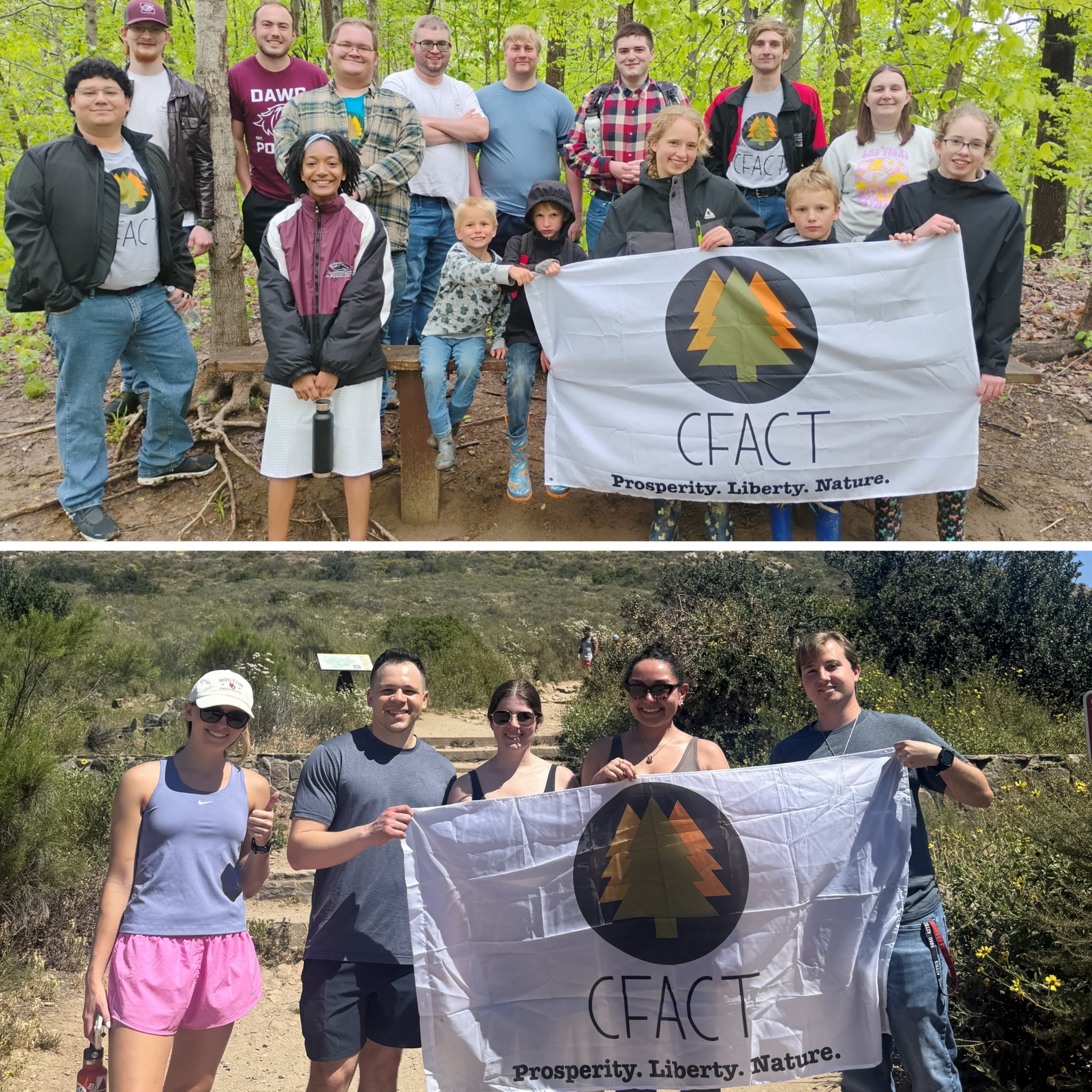
This spring, students in California and Illinois led nature-focused hikes that brought CFACT’s message directly onto the trail. At San Diego State University, CFACT collegians Caleb Rothstein and Jack Krepps led a group hike at Cowles Mountain in Mission Trails Regional Park, providing scenic views of the Pacific Ocean, the perfect visual for attending students as they learned from Caleb and Jack how offshore wind is detrimental to endangered whale species. Despite a heat advisory and some shifting arrival times, the group still brought out 11 attendees for the outing.
The hike also gave newer second-semester members a relaxed opportunity to get plugged into the chapter, meet Caleb and Jack, and see CFACT’s conservation mission in action. Along the way, students handed out CFACT stickers to passers-by, with the “Keep on enjoying nature” sticker proving especially popular.
For Caleb and Jack, the day was a strong start to the semester after earlier scheduling challenges. The hike allowed their chapter to rebuild momentum, spend time in nature, and continue promoting CFACT’s presence in San Diego. As they noted in their event summary, “there’s no better recovery than to take time in nature and continue our advocacy for CFACT in San Diego.”

Meanwhile in Illinois, CFACT collegian Zachary Lochard led a nature walk at Southern Illinois University Carbondale in partnership with the SIUC Conservative Club. The event gave students a chance to discuss the land around them and the growing threat posed by industrial solar, wind, and data center development spreading across the state.
Rather than treating nature as an abstract talking point, Zach connected the issue directly to the landscapes students were walking through. His message was clear: industrial “green” energy projects do not come without environmental costs, and young people should not be afraid to question whether sprawling solar farms and wind projects are truly protecting the natural world.

“Solar farms will continue to wreak havoc on our ecosystem and destroy the natural forests of Illinois,” Zach said. “If we do not stop data centers, solar farms, and wind farms, we will not be able to walk in nature.”
That warning goes to the heart of CFACT’s mission. Conservation is not about empty slogans or blindly supporting whatever politicians label “green.” It is about defending real landscapes, wildlife habitats, and wild spaces from policies that too often sacrifice local ecosystems in the name of climate ideology.
Whether hiking the mountains of California or walking the trails of Carbondale, CFACT collegians are showing their peers that conservation starts with appreciating the outdoors—and then having the courage to defend it.