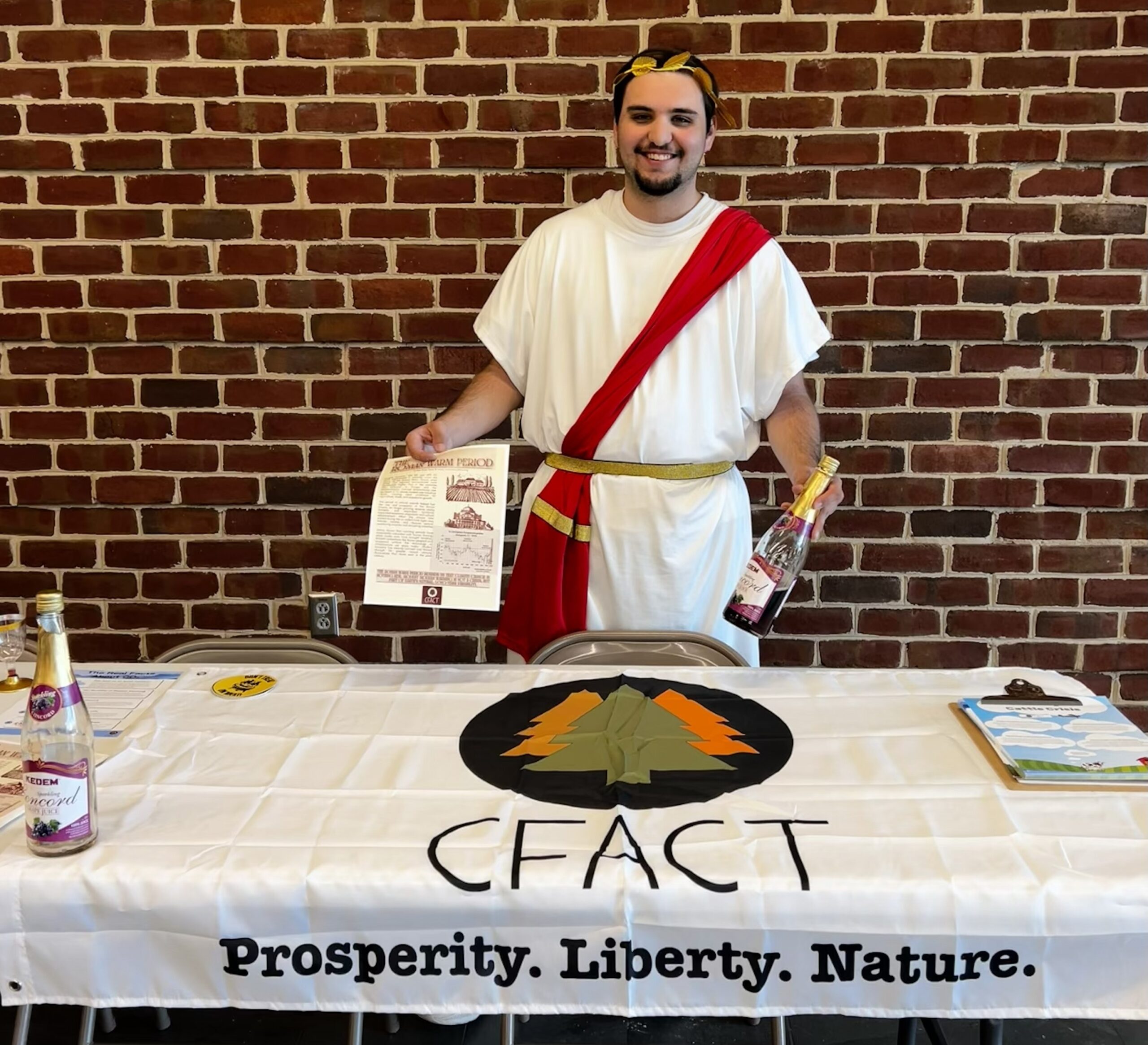
On October 30th, Liberty University student and CFACT Collegian Silas Pearson set up shop in the campus Student Union with an unconventional invitation: “Come taste the climate of the past.” His Roman Warm Period themed Mock Wine Giveaway paired flavor with history to show fellow students that climate change isn’t new—and certainly not catastrophic.

At his table, Silas poured samples of sparkling grape juice into faux goblets labeled as “Roman Wine,” handing them out with flyers illustrating a forgotten truth: Earth’s climate has always fluctuated naturally. The flyer explained that roughly between 250 BC and 400 AD, the world experienced a period of significant warming known as the Roman Warm Period, when average temperatures rose about 3.6°F above pre-industrial levels. Far from disastrous, this warmth ushered in a golden age of agriculture, trade, and prosperity throughout the Mediterranean.
“The Roman Warm Period was a time in history when temperatures began to rise; however, it was a time of great prosperity. Thanks to natural climatic factors leading to modest warming, farmers and vineyard owners could grow greater amounts of crops and, in turn, make more plentiful wine,” Silas told fellow students.
Over the course of the day, Silas spoke with nearly 50 students, many of whom admitted they had never heard of natural climate cycles like the Roman or Medieval Warm Periods. The event sparked lively discussion about how societies have historically thrived during warmer eras and struggled during colder ones—turning a simple tabling session into an exercise in critical thinking.

CFACT’s Climate Realism Campaign encourages students like Silas to challenge the fear-driven climate narrative dominating classrooms and media. Through creative outreach and factual education, Collegians remind their peers that modest modern warming is not a crisis, but a continuation of Earth’s long-term natural variability.
With fake wine in hand and facts on the table, Liberty students left Silas’s event with a more balanced—and less anxious—view of the climate conversation.