Throughout the country, CFACT student “Campus Representatives” are finding creative ways to start conversations about one of the most misunderstood energy sources of our time: nuclear power. Recently, two students—one in Kansas and another in South Carolina—hosted “Nuclear Cookie Giveaway” events that proved a simple sweet treat can spark meaningful dialogue about reliable and clean energy.
At Washburn University, CFACT Collegian McKrae Masters set up shop inside the campus Memorial Union to highlight the many advantages of nuclear energy. What started as a simple tabling event quickly turned into a lively hub of conversation as students and faculty stopped by to learn more.
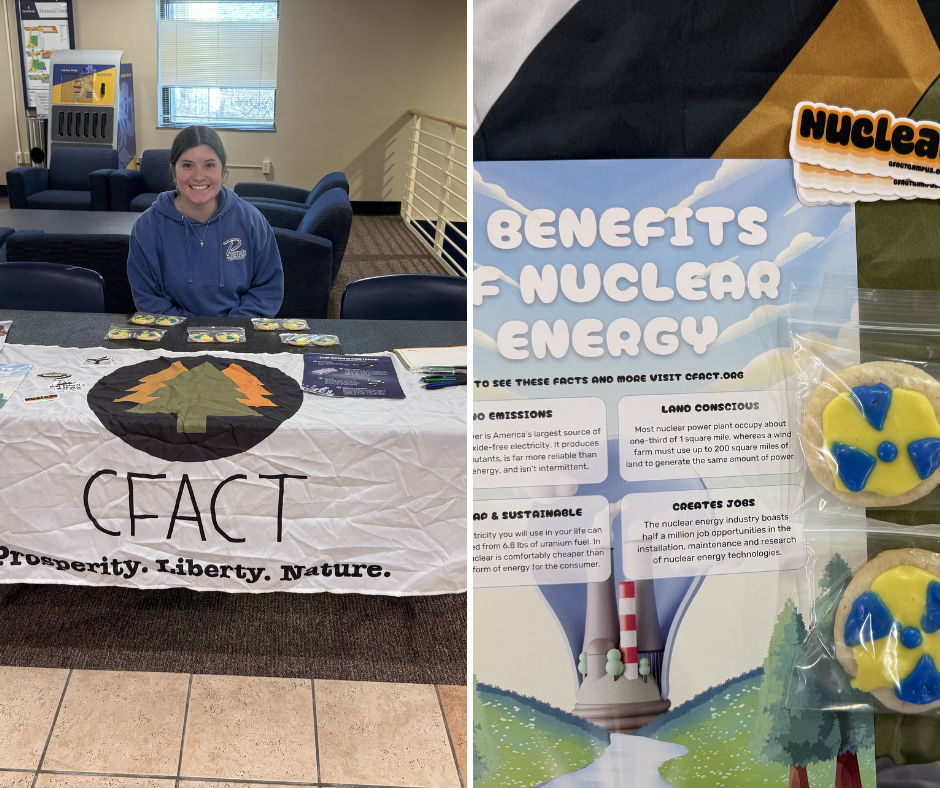
Masters’ table featured informational flyers outlining the “Four Benefits of Nuclear Energy,” along with CFACT stickers and bags of hand-decorated cookies for visitors to enjoy. The cookies—decorated with the “trefoil” or international symbol for radiation—served as an unique icebreaker, encouraging passersby to pause and engage with the material.
Throughout the afternoon, a steady stream of curious students stopped by the table, creating opportunities for thoughtful discussions about nuclear power’s role in job creation, energy reliability, and long-term environmental sustainability. By pairing approachable visuals and treats with substantive information, Masters successfully turned a simple giveaway into a platform for productive campus dialogue.
Meanwhile, hundreds of miles away at Clemson University, CFACT Collegian Anna-Ramsey Watson hosted her own Nuclear Cookie Giveaway on the busy Library Bridge, drawing crowds with homemade cookies decorated with the nuclear fission symbol and nuclear power plant cooling towers.

Watson’s event quickly gained momentum as students gathered around the table, intrigued by the creative presentation and eager to learn more about nuclear energy. Armed with informational flyers and CFACT materials, she engaged visitors in conversations about why nuclear power remains one of the most efficient and reliable energy sources available today.
Interest was especially high among students studying engineering and energy-related fields. Several nuclear engineering students stopped by the table and enthusiastically voiced their support for the message. One attendee summed up the sentiment clearly, telling Watson, “This is great y’all are doing this, nuclear is by far the best energy source, the output far outweighs the dangers and the dangers only happen with negligence.”
The cookies and flyers disappeared quickly—within an hour Watson had handed out the entire supply—but the conversations continued. Some students were so interested in learning more that they snapped photos of the website listed on the back of her shirt rather than even taking a cookie.
From the Carolinas to the Midwest, these events demonstrate how CFACT Collegians are bringing fresh energy to campus discussions about America’s power future. By combining creativity, outreach, and a willingness to engage their peers, students like Masters and Watson are helping their classmates see nuclear energy not as something mysterious or intimidating—but as a practical solution for a prosperous and environmentally-friendly future.